

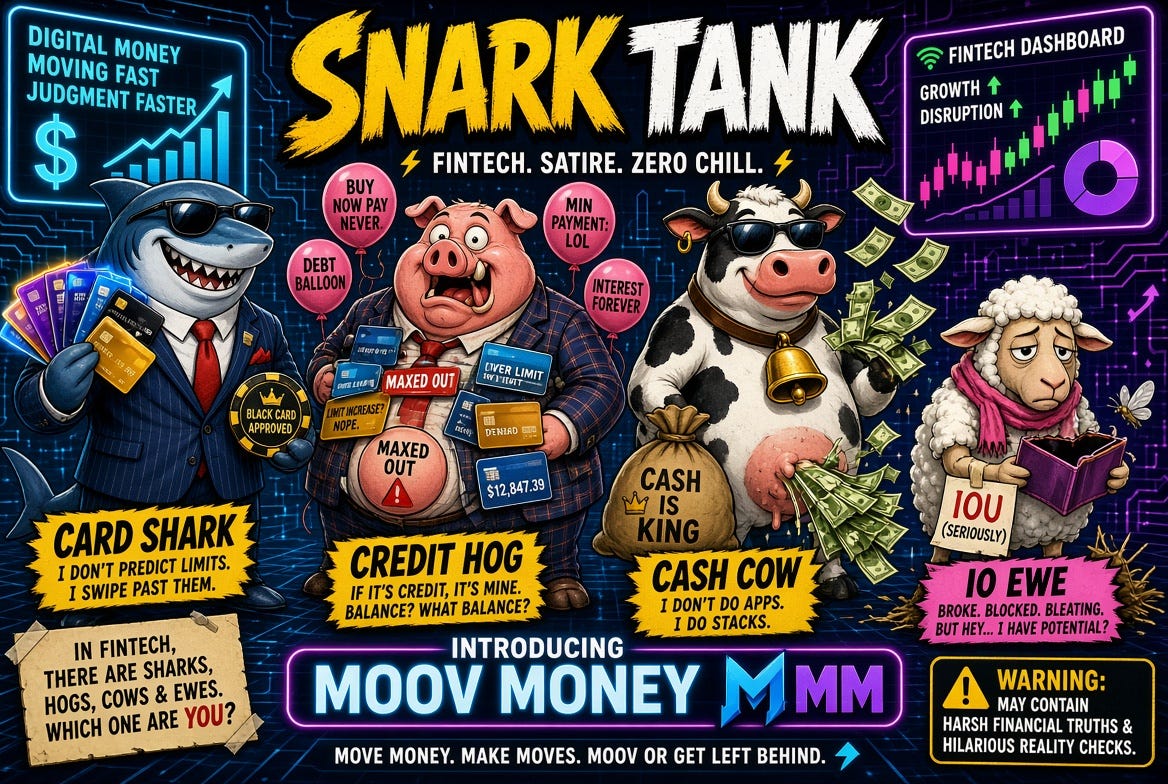
Moov launched Moov Money, a P2P payment service using Visa Direct and Mastercard Move. What’s different: the recipient doesn’t have to use the same app—or even bank with a participating institution—as the sender.
Moov Money lets users send and request payments from their existing banking app. Recipients can claim the money using an eligible debit card, deposit account, or supported wallet, even if their institution doesn’t offer the service.
Jack Henry—whose Banno Digital Platform is the first integration—frames the launch as a relationship play: branded P2P keeps the engagement, and the primary relationship, with the institution.
My take: For most consumers, P2P isn’t much of a primacy driver. For bizumers— half-business owners/half-consumers who earn income from gig work, freelancing, side hustles, and creator platforms—Moov Money could be a deposit acquisition strategy by becoming the mechanism by which bizumers get paid.
Roughly one in four US adults—about 65 million people—are bizumers, and that number could reach 87 million by 2031. More than half (53%) of them use PayPal, Venmo, Cash App, or Square to manage the money side of their business.
The Other Side of P2P
For most consumers, P2P is a convenience. Splitting a dinner tab or utility bill occurs infrequently and in whatever app the participants already use. Offering a new branded P2P service isn’t likely to get them to change how they transact or where they bank.
Bizumers have a different relationship with P2P.
Pet sitters, freelance designers, or furniture resellers receive payments from multiple customers throughout the month. Getting paid fast enough is a top challenge for 25% of bizumers, and the payment apps have established themselves as the primary ways to collect money from customers.
For financial institutions, that creates a problem. PayPal, Venmo, and Cash App are often the first destination for payments to bizumers, and the institution gets whatever money bizumers eventually transfer.
The apps don’t necessarily lose the money. Users hold balances, spend directly from them, or transfer funds to another account. A financial institutions may hold a bizumer’s checking account but not capture much of the income generated by their independent work.
Moov Money offers a way to reverse that relationship.
Consider a freelance designer who receives $2,000 a month from clients through Venmo or PayPal. She transfers some of the money to her checking account, spends some directly from the payment app, and leaves some in the app balance. Her bank sees only a portion of it, while Venmo or PayPal owns the experience of getting paid.
With Moov Money, she could request payment from her banking app and receive the funds directly into her checking account, without requiring her clients to belong to the same institution or even use the same P2P service.
The benefit goes beyond convenience. The institution that captures recurring income has an opportunity to become the account where money accumulates, bills get paid, and additional financial needs emerge.
For most consumers, P2P moves money out of their checking account. For bizumers, it can determine which institution gets their income in the first place.
That gives financial institutions a good reason to offer Moov Money.
Getting Paid Is an Acquisition Strategy
Banks and credit unions have spent years treating P2P as a defensive feature: something they need to offer to keep customers from leaving the banking app.
Bizumers turn that logic around. If Moov Money helps an institution become the destination for money that would otherwise land in a fintech app, P2P starts looking less like a commodity payment feature and more like a deposit acquisition tool.
For the freelance designer, that could mean capturing more of her $2,000 a month at the point of receipt. Multiply that across thousands of bizumers and the economics start to look very different. The institution isn’t waiting for money to be transferred—it’s putting itself at the point where the income enters the financial system.
Turning P2P Into a Primacy Strategy
P2P isn’t enough to win bizumers. They need help managing irregular income, separating personal and business finances, handling taxes, accessing credit, and managing cash flow.
Getting paid is a logical entry point, however. To use Moov Money as more than another digital banking feature, financial institutions need to:
Identify their bizumers and the income that doesn’t reach them. Look for recurring incoming P2P transfers, deposits from gig and creator platforms, transfers from third-party payment apps, and patterns that suggest independent earnings. If bizumers are a meaningful part of the customer base and much of their income is flowing through third-party payment apps, Moov Money becomes more than a service feature—it becomes a potential primacy investment.
Lead with getting paid. The objective here is to give bizumers a reason to request payments from customers through their banking app, not to persuade them to abandon Venmo or Cash App for splitting dinner tabs. Position Moov Money as a way to get paid directly into the account where they manage their finances. Emphasize the ability to request payment without requiring the payer to belong to the same institution or use the same payment app.
Avoid treating bizumers as conventional small-business owners. Many earn money independently without a registered business or a separate business checking account. The appeal is the ability to manage getting paid without having to establish an entirely new financial relationship.
Measure income capture, not P2P adoption. The industry loves to measure digital banking logins, P2P enrollment, and transaction volume. Those metrics won’t tell an institution whether Moov Money is delivering on the bizumer opportunity. The relevant measures are recurring incoming payments, the amount of income captured, balances retained, and subsequent product adoption.
Moovin’ On Up
For most consumers, another way to send money won’t change where they bank. For bizumers, a better way to get paid might. Banks and credit unions have spent years using P2P to keep customers from leaving. Maybe now they can start using it to keep their customers’ money from going somewhere else.
For another take on the Moov Money announcement, check out Chris Rigoni’s post here.
Point 2 is a big one. And I think that’s an approach Revolut is taking.